If Your Roof
Low Slope With a Worn Membrane
Dry insulation, a firm deck and a roof that looks flat from the street.
Start WithA New TPO Membrane

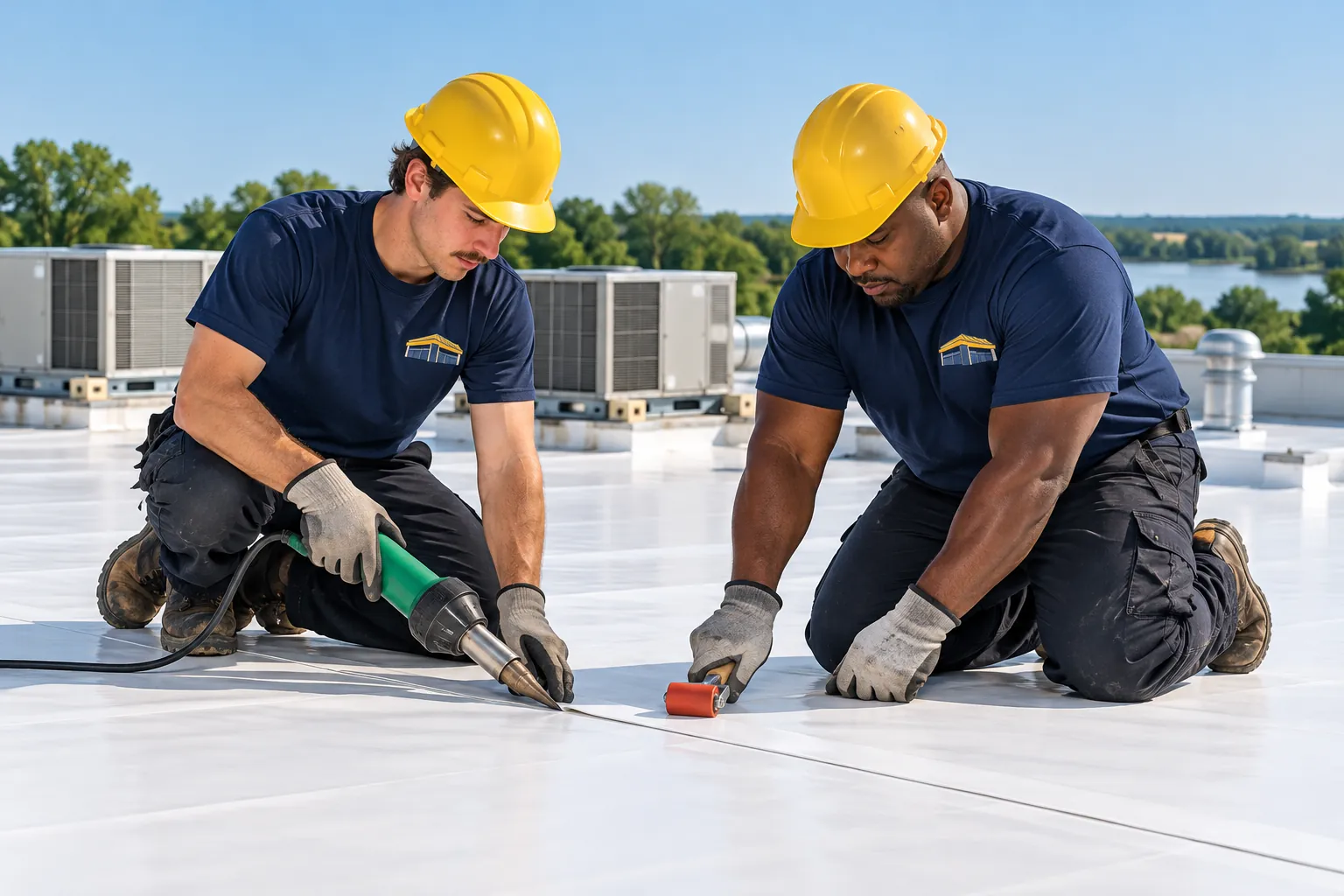
Hire a Paducah TPO roofing contractor to tear off or recover a worn low-slope roof and install white TPO membrane, welded and probed at every seam.
As a Paducah TPO roofing contractor, we start by matching the roof in front of us to one of these four situations.
Dry insulation, a firm deck and a roof that looks flat from the street.
Grease from fan curbs softens many sheets, so the maker's chart gets checked first.
The rest of the field welds still pass a probe test.
Water sheds off panel ends instead of running to interior drains.
Older low-slope roofs give clear signs that a new membrane is due. The first one below is the most common reason owners call about TPO.
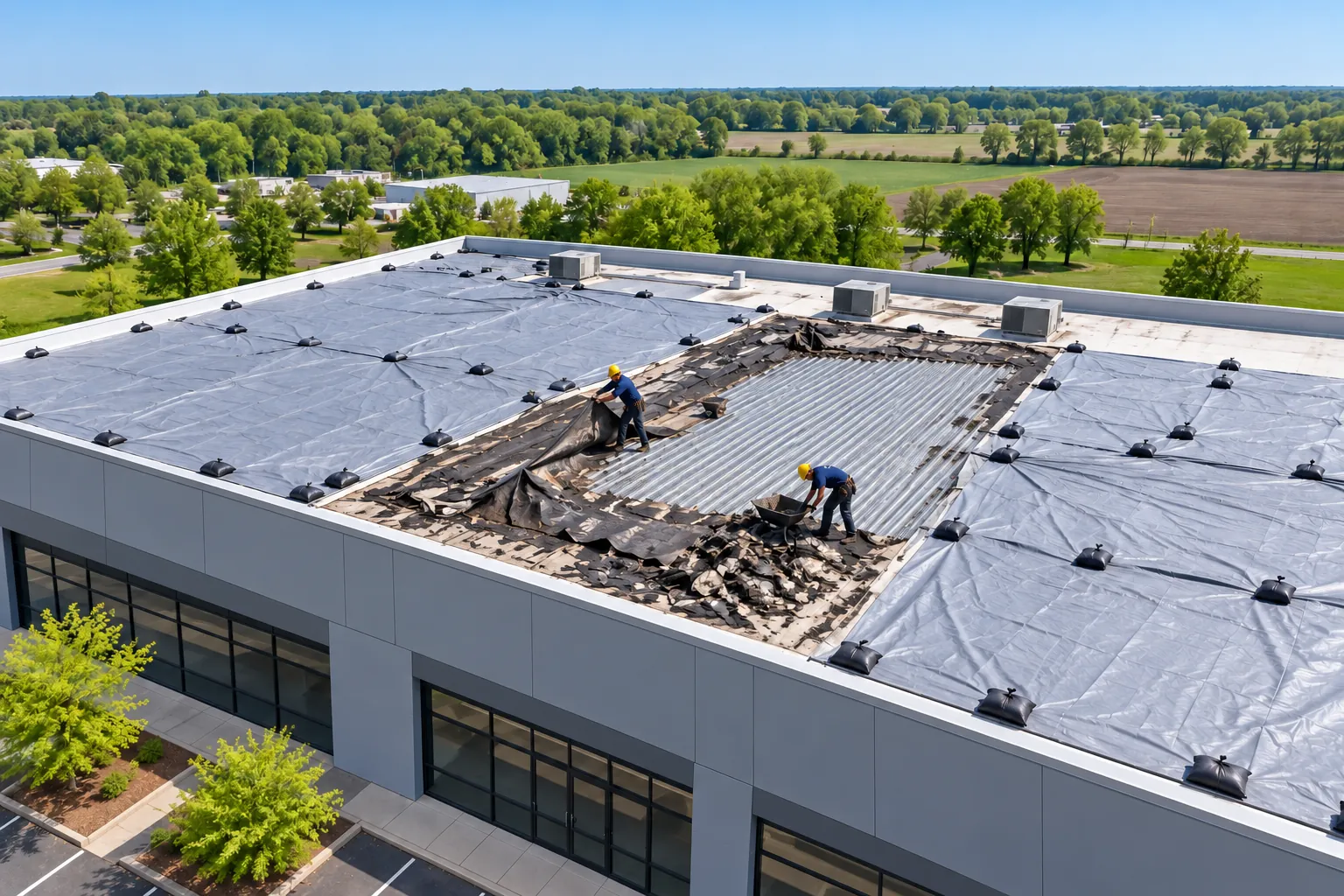
Water that slips through a failed lap soaks the polyiso boards below, and the roof turns soft underfoot. Wet boards lose insulating value, rust a steel deck and feed blisters, so they come out before any new TPO sheet goes down.
Usually Means: Tear-off of the wet areas, then new insulation and membrane.
Inside and outside corners at curbs take the most stress, and old welds there open first.
Dirt rings mark where water sits; tapered insulation under new TPO moves it to the drain.
Years of sun wear the top ply of the membrane thin until the scrim shows through in spots.
On fastened roofs, a sheet that billows between seams points to plates pulling loose.
Thickness, attachment and color are the three choices on every TPO job. The table shows where each option fits on a commercial roof.
| Choice | Option | Where It Fits | Watch For |
|---|---|---|---|
| Thickness | 45 mil | Light-traffic storage roofs | Less margin under hail and boots |
| Thickness | 60 mil | Most warehouse and retail roofs | Walkway pads still needed at units |
| Thickness | 80 mil | Roofs with many units and filter changes | Heavier rolls to stage and lift |
| Attachment | Mechanically attached | Steel decks and large warehouses | Sheet flutter in high wind |
| Attachment | Fully adhered | Many curbs or odd roof shapes | Adhesive temperature limits |
| Color | White, tan or gray | White for cooling; tan or gray to cut glare | Dirt around units lowers reflectance |
Tested reflectance and emittance values for many membranes are listed in the Cool Roof Rating Council directory.
What a new white membrane changes on the roof, for the people working under it, and in the repair budget.
Heat-welded laps fuse two sheets into one, and a test weld on scrap each morning confirms the welder settings for that day's air temperature.
Each rooftop unit curb, pipe boot and drain ring is flashed new and tied into the field sheet instead of patched around.
A white sheet reflects summer sun instead of soaking it up, which takes load off rooftop units serving offices and retail floors below.
Welding runs on hot air from a handheld or walk-behind welder, and adhered sections are scheduled away from air intakes while adhesive cures.
An aged TPO sheet still takes a welded patch once the surface is cleaned and prepped, so small damage stays a small repair.
Heavier 80 mil sheet only where units and boots demand it, and 60 mil elsewhere, keeps the material spend tied to how the roof is used.
Call us with what you see at the seam or curb. A split weld can often be cleaned and patched before water reaches the insulation.
From the first core cut to the last probed seam, this is the order a new TPO roof goes on.

We cut cores to count the layers already on the roof and check whether the insulation is dry, then measure every curb, drain and edge for the takeoff.
Wet boards and failed membrane come off down to the deck. Dry, firm roofs get blisters cut and flattened and a fastened cover board instead.
Polyiso goes down in staggered layers with tapered sections sloped to drains, and crickets are built behind wide rooftop unit curbs.
Sheets are fastened in the laps or adhered over cover board, and a hot-air welder fuses each seam once the morning test weld passes.
Curbs, pipes, drains and walls get flashed, edge metal goes on, and every seam edge is probed with a blunt hook before the final walk.
TPO jobs often lead into one of these, depending on the drains, the leak history and the building next door.
Ponding around drains calls for tapered insulation and new drain bowls under the new TPO sheet.
Flat roofing in PaducahUnheated storage buildings often stay with black rubber, which hides scuffs and joins with seam tape.
EPDM roofing in PaducahSplit corner welds and loose pipe boots on a younger TPO roof get welded patches instead of a new roof.
Commercial roof repairOwners comparing membranes ask these most often. Each row shows the short answer before you open it.
TPO is a single-ply thermoplastic sheet rolled over insulation, with every lap fused by hot air into one membrane. The old roof is torn off or prepared, new insulation and cover board go down, sheets are fastened or adhered, then curbs, drains and edges are flashed. Each section is closed watertight before the crew leaves for the day.
All three are single-ply sheets. TPO and PVC seams are hot-air welded, while EPDM laps join with seam tape. TPO usually comes white, EPDM black or white, and PVC white or light gray. PVC is a common pick near grease fans and EPDM is weak against oils, so the way the roof gets used settles the choice.
Plates and screws in the laps are the usual choice on steel-deck warehouses. Full adhesion over cover board suits roofs crowded with curbs or odd shapes, and ballast only works on decks with spare load capacity. Wind uplift design and an engineer's check of the deck settle the final method before any stone goes on.
A hot-air welder melts the top and bottom sheets together along a lap several inches wide. Crews run test welds on scrap each morning and when the weather shifts, and a good test tears the sheet before the weld lets go. Finished seams are probed along the edge with a blunt hook, and weak spots are rewelded or patched.
Sheets come in 45, 60 and 80 mil, and the heavier sheet holds up better under boots, hail and long sun exposure. A roof with several rooftop units and regular filter changes earns the thicker sheet plus walkway pads. White reflects summer heat, while tan or gray cuts glare toward upper-floor windows.
Send the roof size and what you see at the seams and drains. We will walk the roof and give you a free estimate for new TPO.
Want A Call About Your Roof?
Leave your name and number and we will call you back about the roof.
Or call now: (618) 386-4443