Commercial Roof Repair
Open seams, cracked pipe boots, loose panel laps and storm damage, traced to the entry point and fixed with matching material.
- Dry insulation around the leak
- Damage confined to one area

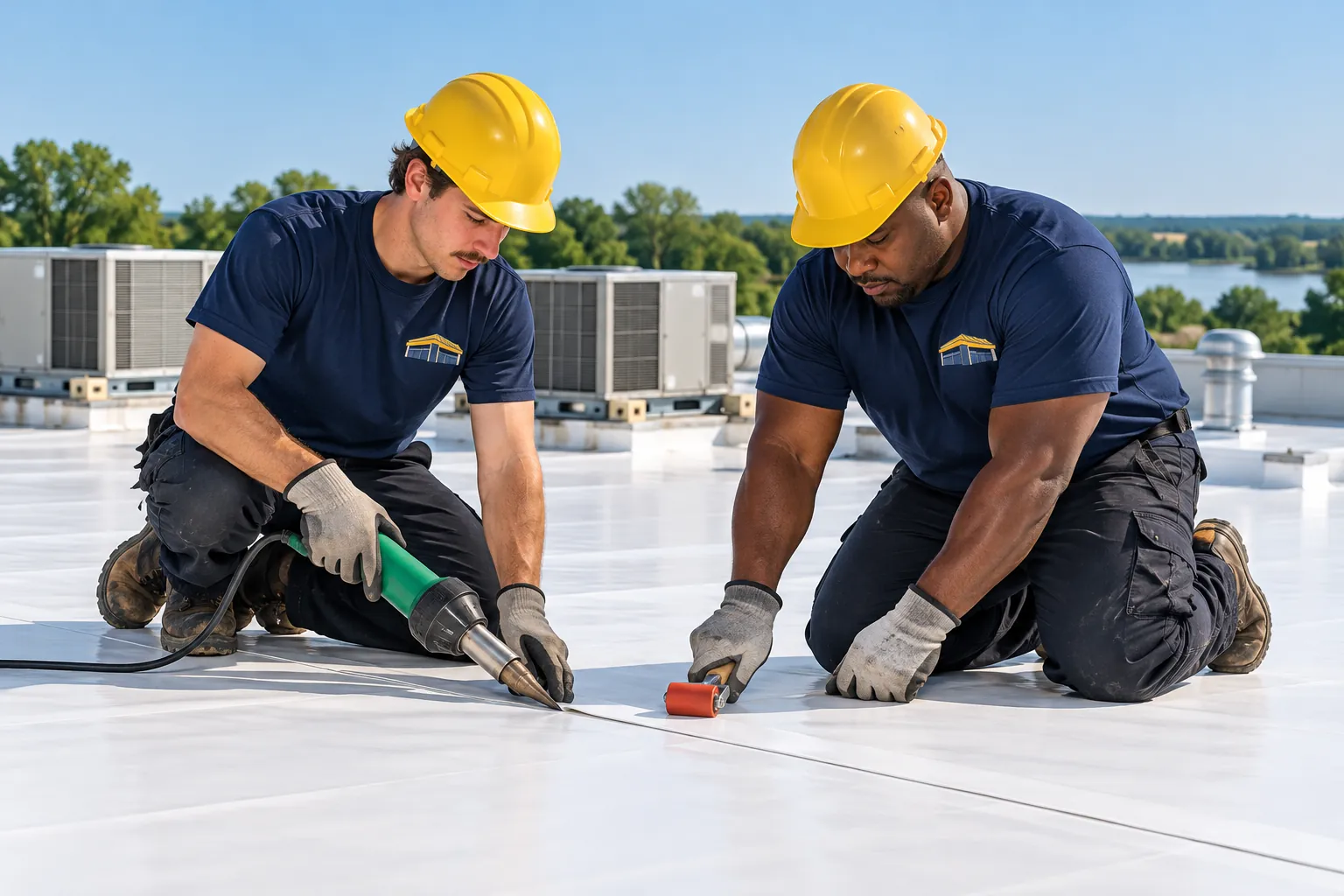
We offer commercial roofing services in Paducah for low-slope and metal roofs: leak repair, TPO, EPDM, flat roof rebuilds, industrial reroofs and metal panels.
Each of our commercial roofing services in Paducah starts with a roof walk. The cards show where each system fits and what it fixes.
Open seams, cracked pipe boots, loose panel laps and storm damage, traced to the entry point and fixed with matching material.
White welded membrane for low-slope warehouses, retail and offices, laid over new insulation and cover board.
Rubber membrane in wide sheets with taped seams, black or white, for low-slope roofs that see hot summers and cold nights.
Tapered insulation, crickets and new drain bowls under a new membrane for roofs that hold water after storms.
Plant and distribution roofs crowded with exhaust fans, stacks and pipe racks, rebuilt in sections around production.
Standing seam and R-panel installation, retrofit framing over flat roofs, and fastener and lap repairs on older steel roofs.
The insulation under the old roof decides which column applies. Core cuts and moisture readings during the inspection settle it.
| Factor | Tear-Off | Recover |
|---|---|---|
| Old insulation | Removed; new boards installed | Stays only if dry and firm |
| Roof deck | Exposed, rusted areas repaired | Stays covered |
| Roof weight | Back to a single roof | Adds one more layer |
| Debris and noise | More of both | Less of both |
| Edges and curbs | Rebuilt to the new height | Raised for the added thickness |
| Code limit | None for this choice | Ruled out over soaked boards or two existing layers |
The code limit comes from the model building code behind the Kentucky Building Code; the local building office confirms how it applies to each roof.
Start with what the roof looks like today. Each card points to the service that usually comes first on a roof like it.
Moisture readings around the stain come back dry.
Cores show dry insulation and only one existing roof layer.
Rings around drains and along the eave line stay for days.
Stacks and grease fans leave a film on the membrane.
Soft spots underfoot and readings that mark wide wet areas.
Call us and tell us where water is showing up inside. We will set up a roof walk and talk through repair before replacement.
A full replacement follows the same order on a warehouse, a plant or a strip center, with the building open the whole time.
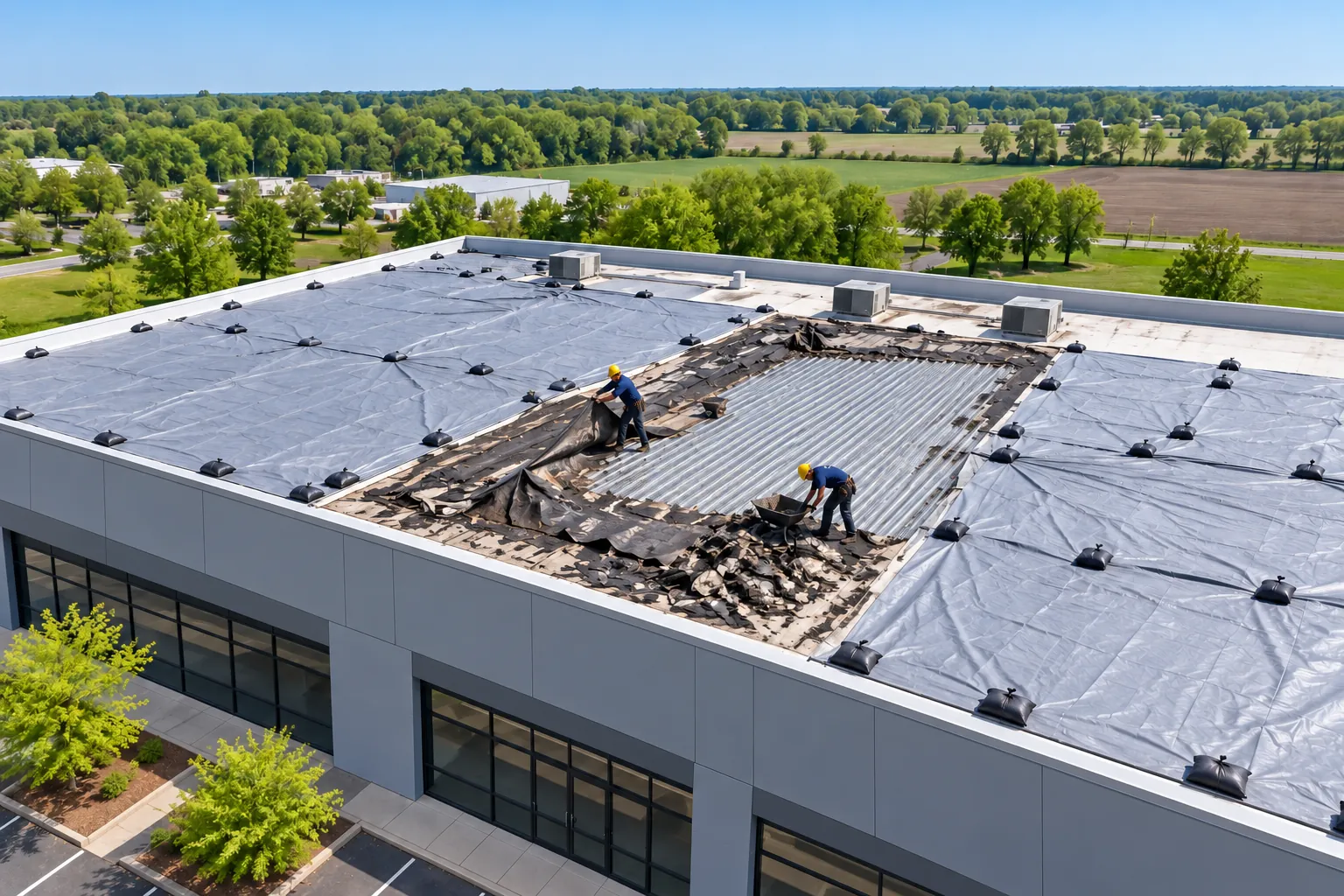
Core cuts and moisture readings show how much insulation is wet, and that share drives the repair, recover or replace decision more than the roof's age.
Crane and lift spots go away from entrances, rooftop unit shutdowns are timed with building staff, and covered walkways go up at doors under active edges.
Only the area that can be dried in by evening gets opened. Stock and equipment under steel-deck work areas are covered, since debris can drop through the flutes.
Polyiso goes down at the level the commercial energy code sets, in staggered layers with tapered sections, then cover board and the new membrane or panels.
Edge metal tested for wind uplift, coping on continuous cleats, counterflashing in reglets and new drain bowls finish the roof, with corners fastened closest.
Owners planning a replacement ask these first, including the signs a commercial roof needs replacement and whether the business can stay open.
Replacement makes sense when the membrane or panels are worn across most of the roof, the insulation underneath is wet, or repairs keep failing in new places. A roof walk shows it: seams opening across the field, blisters and shrinkage pulling flashing off walls, soft spots underfoot, or rust holes at panel ends.
The old insulation decides. Dry, firm boards under a single roof layer can take a recover, which adds a layer and raises the edges and curbs. Wet boards, or a roof that already has two layers, call for tear-off down to the deck, which also opens rusted deck sections to repair.
Wet boards are removed and new polyiso goes in at the level the commercial energy code sets, often with tapered sections that pull water toward drains. Boards are staggered so joints never line up, cover board goes over the top, and crickets sit behind wide curbs. Edge metal and curb flashing are built to the new height.
Yes. Work moves section by section, and each one is sealed watertight before the crew leaves for the day, with a temporary tie-off holding rain out of the next area. Lift spots stay clear of entrances, doors under active edges get covered walkways, and unit shutdowns are timed with building staff.
A full replacement rebuilds the perimeter and every detail along with the membrane: edge metal rated for wind uplift, coping caps reset on continuous cleats, counterflashing set into reglets in masonry walls, new or retrofitted drain bowls and strainers, and scuppers or gutters sized for heavy storms. Corners get the tightest fastening.
Six layers do the work: the structural deck, a vapor retarder, insulation, cover board, the membrane or panels, and the edge metal and flashing that close the perimeter. Replacing a roof means choosing each of those layers, and the edges deserve as much attention as the open field because most leaks start there.
If the roof looks flat from the ground but still drains, it is low-slope and takes a membrane such as TPO or EPDM. Visible pitch with panels running from a ridge cap to the eave means metal works. Ponding rings around drains or along the eave show where slope is too shallow for the covering on it.
Spring through fall gives the most working days, since adhesives, primers and seam tape all have minimum temperatures. Summer brings long days and quick adhesive set but a hot membrane, while fall offers steady weather with short days and morning dew. Winter jobs lean on fastened sheets and welded seams that need less adhesive.
Describe the roof and the building. We will walk it, take cores and give you a free estimate for repair, recover or replacement.
Want A Call About Your Roof?
Leave your name and number and we will call you back about the roof.
Or call now: (618) 386-4443